Mad Max Fury Road is full of names: weird, inventive, evocative names. But it also uses them brilliantly. There’s so much information packed into what names are spoken, when and how.
Names and titles are a
classic way of revealing hierarchy. Joe is named repeatedly, and each time it
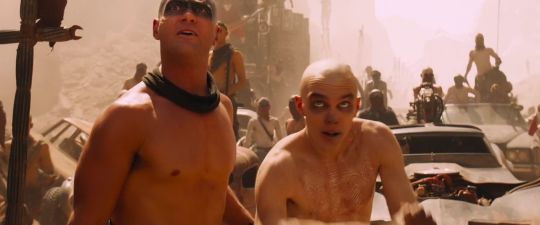
shows his relationship with the person naming him. Nux’s “Immortan! Immortan
Joe!” is all about his godlike status. The Organic Mechanic’s “Joe” is deliberately
casual, not actively disrespectful but certainly not worshipful.
Then there’s
the ongoing tension in what Joe calls Angharad: “Splendid” most of the time,
reverting to her proper name at moments of stress, when he really needs her to
listen. In the canyon scene, he goes from “Splendid, that’s my child, my property” when he’s trying to rebuke her to “Angharad! Get out!” when he realises she’s at risk of hitting the rock. It’s implied that she rejects “Splendid” – certainly the other wives
only ever call her Angharad. (More generally, the wives use each other’s names simply, to get each other’s attention: I don’t get any sense of hierarchy from it.)
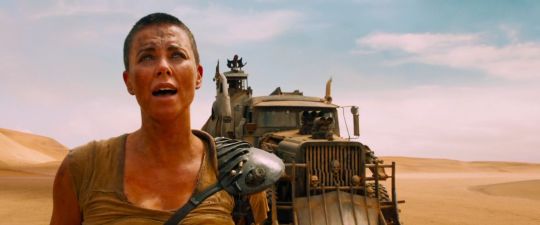
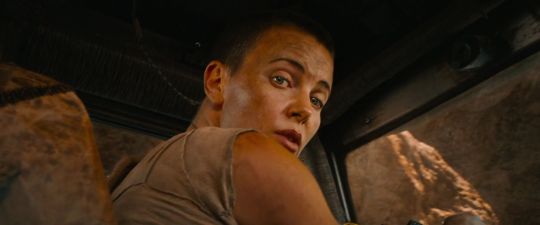
On screen, Furiosa explicitly uses names to form connections. When she asks for
Max’s name, it’s a deliberate attempt to achieve emotional engagement, because
she needs him on side. And it’s rare for her: not only does she not name the wives, she doesn’t use the war rig crew’s names,
either. In a movie that keeps its dialogue sparse, every word counts – and every omitted word counts, too.
Within the Citadel hierarchy,
war boys don’t get named by anyone but each other. “I’ve got a war boy, running
on empty,” says the Organic Mechanic. An imperator later uses exactly the
same phrasing to introduce Nux to Joe: “I’ve got a war boy, says he
was on the war rig”. It suggests that, from the top of the Citadel hierarchy,
war boys are seen as interchangeable.
One describes Nux as if he were a machine; the other – “says he was on the war rig” – implies his lower status, framing his evidence as hearsay.
It’s clearly a huge honour for Joe to ask
Nux his name. It’s also the only time we see a Citadel full-life acknowledge a
war boy’s name.
War boys in this film
are both abusers and victims – terribly fragile, desperate for attention from
the powerful class that exploits and uses them, not questioning its
values. They go unnamed by their superiors, but they name each other as
often as possible: “Morsov!” “Slit, what’s happening?” Though Nux shouts “Crew,
out of the way!” at Ace – maybe they don’t know names beyond their own crews,
or maybe he just doesn’t recognise Ace from behind.
They use names to
encourage each other. Just look at the way they all shout Morsov’s name before
witnessing him. “Witness me” is a plea for affirmation: see what I’m
doing, make it mean something. Witnessing is an act of performative masculinity – I liked @bookishandi‘s post on witnessing Nux’s death. But it’s also framed as an act of mutual support
(which I think is why it’s taken off so much in fandom). Morsov’s death – which is really the viewer’s
introduction to “witnessing” as a concept – is part of a scene that shows
us the war rig crew working smoothly together.
The exception is Slit,
who tries to undermine his colleagues instead, shouting “Mediocre,
Morsov!” rather than “witness”, or telling Nux that Joe wasn’t looking at
him, “He was scanning the horizon”. And of course Slit is the most
insecure of the lot, begging for any scrap of attention: “I got the
blood bag’s boot! Take me, I got his boot!”
Imperators, and others
from the Citadel’s powerful classes, are clearly known by their names. “Furiosa,
she took a lot of stuff from Immortan Joe”, for instance. There’s no sense that
war boys give this recognition to anyone not at the top of that hierarchy. The war boy who
tells Nux about Furiosa talks about the wives as things
– “stuff”, “prize breeders”. Nux’s own reaction to the wives
– “so shiny, so chrome” – sees them as objects rather than people. And of
course he goes on calling Max “blood bag”, even when he thinks they’re on
the same side. It’s not a conscoius insult; it clearly doesn’t occur to him that Max
might mind – any more than Nux minded the way the Organic Mechanic or the imperator talked about him.
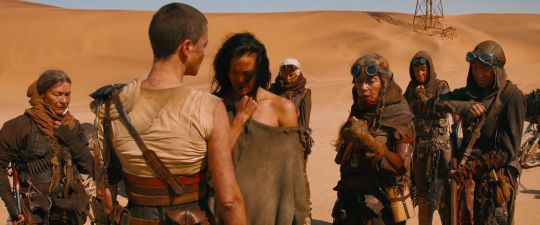
Then there’s the scene when Furiosa greets the Vuvalini. Here’s what she says:
“I am one of the Vuvalini, the Many
Mothers. My initiate mother was K.T. Concannon. I am the daughter of Mary
Jobassa. My clan was Swaddle Dog.”
This is a speech proving her identity, but how she does it is so revealing. She doesn’t
use her own name at all. Instead, it’s all about a web of relationships, of
connections, the ways in which she belongs. (She’s also proving that she belongs by demonstrating knowledge of Vuvalini society.) She lists her initiate mother
before her birth mother – her place in the community before her lineage. Her
tenses are interesting, too. Her clan was
Swaddle Dog – she’s left, the clan may no longer exist, she’s talking about the
past. But when she talks about being Vuvalini, it’s “I am”. Even though she’s asking for recognition, it
has none of the war boys’ neediness – she’s naming what she is, how she chooses
to see herself. She’s not seeking approval or affirmation.
And though the
Vuvalini team work is smooth, they do it without shouting
names – to the point where most of the Vuvalini characters don’t have names at
all (which is very unhelpful for fandom, George). Citadel naming is intensely
hierarchical, about who does, and doesn’t, get respect. Vuvalini naming is
about community, identities built up through choices and relationships.
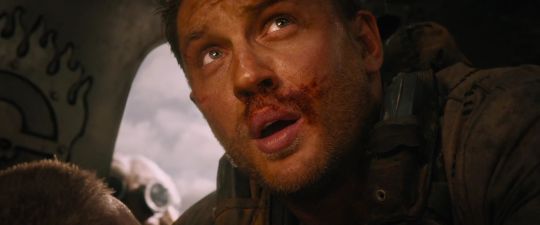
Of course, the film’s most powerful naming scene has nothing to do with the Citadel or the Vuvalini: it’s Max telling Furiosa his name. (OH MY HEART.) It’s the conclusion of Max’s emotional arc, his return to being a human being: accepting a name, accepting his own identity. Crucially, he accepts it by sharing it. Throughout the film, names are meaningful because they’re how people connect with each other. In the “My name is Max” scene, we see Max choosing to do that. Engage to heal.
Over three decades Transformers has grown from a line of children’s toys to a media franchise encompassing film, TV and gaming. Perhaps its most radical spin-off though is a comic that has used wit and humanity to reach a new, diverse fan base. – BBC News
A few more thoughts on my comics catch-up before OP ends:
Revolutionaries
While Revolution is a mess, Revolutionaries is surprisingly delightful. The team is really sweet – I love Mayday, I continue to love Blackrock because who doesn’t love cocky secret Cybertronian Tony Stark?, and Action Man is actually a lot of fun when he isn’t irritatingly panting after Arcee (ahem, Optimus Prime). Also, Kup is the most adorable old man. I can’t get over his friendship with Ian, and the fact that when Ian meets Ayana, Kup is just like, “You made a human friend!! I’m so proud of you, kid!” and practically starts arranging play dates. 😀 (And then when Kup and Ayana come to rescue him, Action Man’s first response is, “You brought my human friend!” It’s almost painfully cute!)
Revolutionaries also manages to pull off what Revolution does not in that it gives you some kind of hook for all the characters, no matter how briefly they appear. I felt more for Mayday’s G.I. Joe team during the two pages where they actually appeared before being mutated than I did for the entirety of the G.I. Joe cast in Revolution.
Which is not to say Revolutionaries is perfect; I think it does suffer from trying to cram together three eras of G.I. Joe with three largely different casts, and I’m ambivalent about the retconning of Hearts of Steel from a charming little G1 AU to a cynical and cruel experiment by Shockwave. However, it does pretty damned well with the material it has, I’m just saying.
I think turning Sgt. Savage into a kind of IDW Steve Rogers – a WWII hero who suddenly rocks up in the modern day and turns out to be younger, less cynical, more wholeheartedly into embracing the future, and a lot less down for morally grey government bullshit than anyone imagined – works surprisingly well.
The way the series plays with genre – like through the Encyclopedia-Brown-style adventures of “Mikey Power”, kid detective, and the mix of pulpy mid-20th century adventure with X-treeeeme 90s comics and more modern storytelling – is inventive and cool, and actually pulls a lot of weight in terms of establishing both the characters and the historical evolution of G.I. Joe as an idea. For someone coming in with very little background in G.I. Joe, it was great.
First Strike
First Strike is really solid, thanks in no small part, I suspect, to Mairghread Scott’s writing. In a lot of ways, this is the book I think Revolution should have been. It’s a crossover where it’s easy to feel for both sides, and where both sides nevertheless have very valid reasons to distrust one another. Having humans attack Earth’s induction into the Council of Worlds on Cybertron is a great plot hook: it’s high-stakes, it’s intense, you’ve instantly got a reason for both the Cybertronians and G.I. Joe to swarm the scene and quite naturally turn on each other. And the way it’s pulled off is visceral, unlike the oddly stilted “I guess we fight because now is the time for the two of us to fight” feeling I got from Revolution.
I’ll tell you something else: Joe Colton is ten times the human villain Spite Witwicky ever was. This is how Spike’s story should have gone! Colton is fantastically written: He’s a good man who ends up conspiring with terrible people to commit an atrocity, for a reason that’s understandable in a horrifying sort of way. He understands that what he’s doing is genocide, and he’s not even doing it because he hates Cybertronians. He gets that some of them are good and want to help humanity. He just knows that humans are like ants to them, and another Cybertronian war might well wipe Earth off the face of the galaxy – not because the Autobots want to hurt us, but because their power is so staggeringly above our own that a careless step could crush us. That’s so much more interesting than Spike’s… I don’t even know what the hell was going on with Spike. Spike’s “you’re all talking toasters and I hate machines because my dad used to take me fishing but I hate him too kind of”… thing.
Colton’s relationship with Scarlett is also very well written. It’s moving – so moving, in fact, that it’s easy to fall into the same trap Scarlett does, and want to believe that Colton is leading her to him because he wants to be stopped. The fact that he doesn’t – he just wants her to understand – breaks my heart. (And hers, I don’t doubt.)
I really find Manheim deeply uninteresting, though. His (already fairly weak) morally grey/doing this for the greater good schtick from Revolution becomes completely superfluous given Colton’s arc here, and by the end I kept hoping Shazraella would drop him.
Soundwave and Scarlett actually being friendly with one another – and Soundwave being able to relate to the pain of your beloved mentor going off the rails – warms my heart.
I am also a huge fan of the Torchbearer twins and their friendship with Soundwave, where they just run around fighting shit and doing Science! and finishing each other’s sentences, and Soundwave just beams at his two bizarre and wonderful Camien daughters. 😀
The Cybertronian politics in this crossover are actually really on point (again, I suspect because Scott wrote it and they’re directly continued from the pages of TAAO). One detail I particularly enjoy is that, despite the fact there’s no love lost between them, Starscream long ago learned to trust Soundwave’s perception and judgement, and he still does.
This series could have been subtitled, “Local Prime Is Completely Useless, Says Everyone” and I appreciate that immensely. 😛
stop calling every piece of fabric with a plaid pattern “flannel”
flannel is a soft, warm cotton. it has nothing to do with what pattern is on the cloth
I see there’s drama in the plaid fandom
im a lesbian
So am i and i say every plaid is flannel! You can’t change my mind! See that plaid blanket over there?? That’s flannel. The latitude and longitude grid on world maps? That’s a nice flannel you got there buddy
hey are you free this saturday night. id like to meet up and have a passionate discussion with you
i can’t tell whether that’s a callout or an ask-out
Oooh! I have Beast Wars/Machines to thank for getting me into TF in the first place. You’re in for a fun ride 🙂 (might do my own rewatch of BM, it’s been a few years) Glad your sticking around, Tumblr wouldn’t be the same without you ^.^
Thank you, my dear! ❤ And absolutely, go for it! It’d be fun if we both ended up rewatching. I’m really looking forward to a trip back to the Beast era. 🙂
Beast Machines was the first Transformers series I ever watched, and I still have kind of a soft spot for it. It’ll be fun to hear what you think of it! (I’m kind of bummed that my DVDs are currently still in England – it’d be a good excuse to rewatch them.)
Thanks! And that’s really cool – I know some fans can be negative about Beast Machines, so it’s cool to hear that you liked it enough to check out everything else! (Did Beast Machines inspire you to dive into the rest of the franchise, or did you come back to it later?)
Alternatively, he’s in it for the resume: “I strangled God and fucked the Chaos-Bringer!”
OH MY GOD HE ABSOLUTELY WOULD.
And still no one would believe him, because he’d say it in the same breath as he’d say that he was super unvincible and you spell his name with an explosion noise and he once beat up Megatron (and one of those is actually true, too!).
I met a traveller from an antique land Who said: “Two vast and trunkless legs of stone Stand in the desert. Near them, on the sand, Half sunk, a shattered visage lies, whose frown, And wrinkled lip, and sneer of cold command, Tell that its sculptor well those passions read Which yet survive, stamped on these lifeless things, The hand that mocked them and the heart that fed: And on the pedestal these words appear: ‘My name is Ozymandias, king of kings: Look on my works, ye Mighty, and despair!’ Nothing beside remains. Round the decay Of that colossal wreck, boundless and bare The lone and level sands stretch far away.”
I met a programmer the other day Who said “A vast and blocky plastic box Stands in my workspace; in it, so they say Half-dead, a chip from Intel lies, which clocks 566 M-hertz; the CD drive And fifteen gigs, and bundled AOL Must have seemed neat when Reagan was alive But now the stickers on its lifeless shell Seem only fit sad memories to revive And on the light beige case are words that say: “THIS COMPUTER IS NEVER OBSOLETE SURF! INVEST! EMAIL! TYPE! SHOP! TRAVEL! PLAY!” The monitor is dark; near its defeat My new and shiny MacBook whirs away
Whirl would. Whirl WOULD. Whirl has no sense of perspective and no fear of death; of course he’d develop a crush on the killer planet. They are both (physically and metaphorically) prickly death machines with a whole encyclopedia’s worth of issues, who are also both fonder of Rung than you (or he) would imagine. This relationship might actually work.



 Decepticonsensual's Armada